
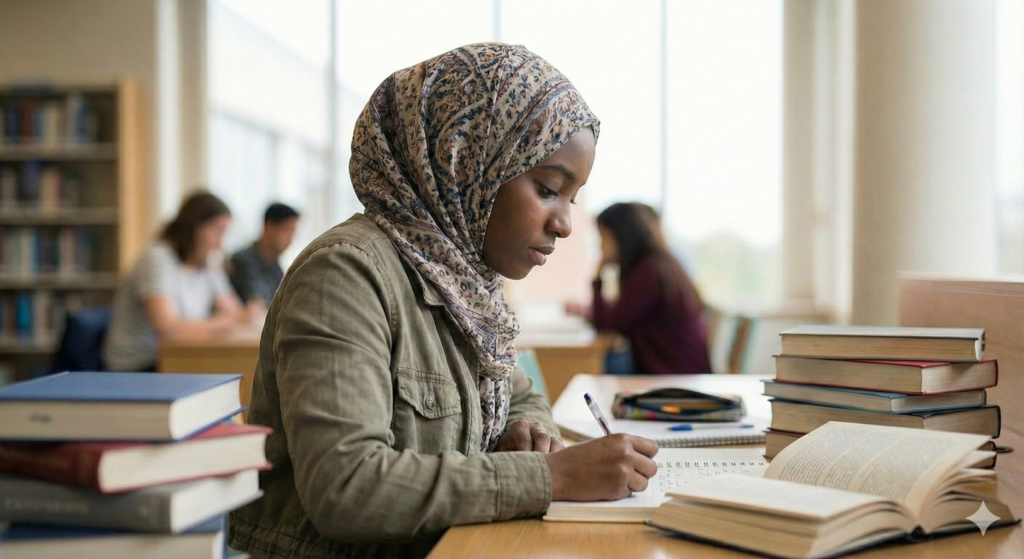
A new study has highlighted the “structural and cultural exclusions” faced by Black Muslim women in UK higher education, revealing a significant gap between university diversity pledges and the daily realities of students.
The research, published in Human Rights Education Review by Dr Sadiya Osman, warns that despite institutional commitments to equality, many students continue to navigate an academic environment defined by racism, religious discrimination, and systemic marginalisation.
The ‘Intersectional’ Barrier
The study utilised “intersectionality theory” to examine how the overlapping identities of race, gender, and religion create unique barriers. By conducting in-depth interviews with 16 Black Muslim women—ranging from undergraduates to doctoral candidates—the researcher explored how these students’ rights to a non-discriminatory education are being tested.
The findings suggest that these women often experience a phenomenon of being both “hyper visible” and “invisible.” While their religious or racial identities might make them feel scrutinised or “watched” on campus, their specific needs and cultural perspectives are frequently overlooked in the classroom and in university policy.
Participants reported encountering hostile learning environments and a lack of “culturally responsive” support systems. The study concludes that many UK universities remain rooted in Eurocentric norms, which can make students feel like outsiders in their own places of study.
What This Means for Students
For Black women in academia, the research offers a vital validation of their lived experiences. It highlights that the challenges they face are often not isolated incidents, but part of a broader systemic issue where “Equality, Diversity, and Inclusion” (EDI) initiatives may only be “superficial.”
Key takeaways for students and advocates include:
- Understanding Intersectionality: Recognising that the combination of being Black, female, and Muslim creates specific experiences that cannot be simplified into just one category.
- The Right to Education: The study frames these experiences within a human rights context, asserting that a true “right to education” must include the right to an environment free from discrimination and exclusion.
- The Need for Decolonisation: Findings point to the importance of “decolonising” the curriculum—moving beyond white, Western-centric reading lists to include a wider range of global and minority perspectives.
The report concludes that true equality in higher education will only be achieved if universities match long-term academic research with a genuine institutional commitment to dismantling barriers for all students.
Source: https://www.tandfonline.com/doi/full/10.1080/25355406.2025.2520273?src=exp-la&#d1e634